Bison Battle slot (2026): mechanics, RTP reality, and how the bonus rounds work
Bison Battle is often mislabelled online as a Yggdrasil release, but the official game belongs to Push Gaming. That distinction matters because provider documentation is where you check the reel set-up, feature behaviour, and operator-configurable RTP versions. This guide focuses on how the game actually plays in 2026: what triggers the “clash” events, how the two main bonus modes differ, and what the published RTP and volatility statements mean in practice.
Game basics: layout, paylines, and what “high volatility” means here
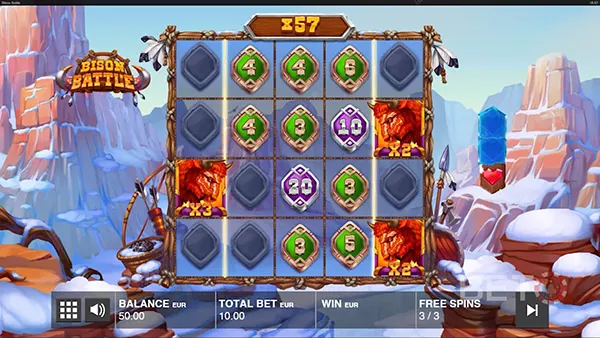
Bison Battle runs on a 5-reel, 4-row grid with fixed paylines (commonly listed as 20). Wins are paid left to right in the usual way, and the core experience is built around special bison symbols that appear under certain conditions. If you have seen “ways” figures attached to the game, treat them as third-party shorthand rather than the underlying pay mechanic.
In 2026, the most important technical point for players is that Bison Battle is a high-volatility slot. That does not mean it “pays less”; it means outcomes tend to cluster: longer quiet stretches can be followed by sharp swings when features connect. This affects bankroll management more than almost any other single factor, so it is worth deciding on a session budget and stake size before you spin.
RTP is not always one fixed number. Operators can run different RTP configurations, so two versions of “the same” game can have slightly different long-term expected returns. If an online casino publishes the RTP in its help files (or in the game info panel), that is the number you should rely on for that specific lobby, not a generic review figure.
RTP and payout potential: what’s published, what varies, and what to check
Many reputable trackers list a default RTP around the mid-96% region for Bison Battle, while also noting that alternative RTP settings exist. In practical terms, you should expect a small difference in long-run value across versions, but the short-run experience is dominated by volatility rather than by a one-point RTP swing.
Maximum win claims also need context. Bison Battle is widely reported with a very high headline maximum (tens of thousands of times your stake). That figure is a theoretical ceiling tied to a precise chain of events, and it should not be treated as a realistic expectation for any single session. The useful takeaway is simply that the game has room for outsized outcomes when the strongest feature states align.
Before playing with real money, open the in-game information screen and check: RTP (if stated), bet range, and feature rules. If the RTP is not shown, some sites publish it elsewhere in their support pages; if neither is available, you are relying on estimates, which is never ideal for making an informed choice.
Bison Clash in the base game: how the trigger works and why it matters
The base game’s identity is the “clash” concept: special bison symbols can land in a way that initiates a clash event. Depending on the symbol type and its values, the clash can award instant prizes, apply multipliers, or progress you towards one of the main feature modes. It is a simple idea, but it creates many mid-sized peaks rather than making all excitement wait for a single scatter-triggered bonus.
One reason players misread the game is that it mixes two styles: traditional line-slot spins and modern “value-carrying” symbols. A value bison is not the same thing as a normal premium symbol; you are not hoping for five-of-a-kind, you are hoping for the right symbol interaction on the right row. That changes what a “good” spin looks like.
If you want to understand whether the slot suits you, watch for how often clashes appear at your stake level and how frequently they translate into meaningful returns. High volatility can still feel fair if the base game regularly produces smaller feature-related wins that offset the dead spins.
Green Valley-style sticky wild rows: upgrades, multipliers, and momentum
One of the key bonus experiences is built around sticky wild rows (commonly described on reels 2–4). The idea is that a wild row can lock in place for the feature duration, and subsequent interactions can upgrade its multiplier. This is where Bison Battle can turn a modest start into a strong finish, because multipliers apply to line wins that connect through those sticky wilds.
Upgrades are typically driven by further bison interactions during the feature. Instead of “waiting for a retrigger”, you are often watching for incremental improvements: another upgrade step, another multiplier bump, another chance to connect premium symbols through the same locked wild structure. That pacing is why the mode can feel more tactical than a standard free spins set.
From a player-experience angle, this feature tends to create fewer but chunkier outcomes: long stretches of small returns can flip quickly once multiplier rows are in place. If you are sensitive to variance, this is the part of the game that will feel the most extreme—both on the upside and on the downside.
Ice Park-style coin feature: collecting values and chasing the best grid states
The second main bonus mode is commonly described as a “coin collection” or “hold-and-win style” feature. Instead of relying on line wins, you are focusing on landing and retaining value symbols, building a board state that can be cashed out at the end. The rhythm is different: fewer traditional spins, more suspense around whether the grid fills or upgrades.
Value ranges in these features are usually wide. Small coin values are common, while high-value events are rare but meaningful. This is another area where different RTP settings can subtly alter long-run averages, but moment-to-moment, the experience is governed by how often you can add new value symbols before the feature ends.
In terms of expectations, treat this mode as your “variance amplifier”. A middling round can pay something close to your stake back, while a strong round can dwarf the base game. If you are evaluating the slot in demo mode, this is the feature worth sampling most, because it shows you the game’s best-case rhythm without needing thousands of spins.
Practical play notes for 2026: demo testing, bankroll limits, and responsible habits
If you are assessing Bison Battle in 2026, start with demo play to confirm the feel of the clash frequency and the bonus pacing. Demo sessions are useful for learning symbol behaviour and feature transitions, but they do not guarantee your real-money experience will match, especially in a high-volatility title.
Set a session limit first, not after you start. Because the game can run cold for long stretches, it is easy to raise stakes impulsively to “force” action. The maths does not work that way, and stake jumps increase loss speed far more reliably than they increase returns. A steady stake with a clear stop point is the simplest guardrail.
Finally, remember that RTP is a long-run theoretical measure, not a promise. The only controllable levers are bet size, session length, and whether you stop when you hit your limit. If gambling stops being entertainment, use the casino’s safer gambling tools (deposit limits, time-outs, self-exclusion) and step away.